CONSERVATION CORNER
A weekly blog for all things conservation

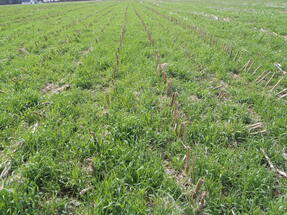 By: Kevin Brown, Ag. Resource Specialist It is that time of year again. For the very important, local people that bring food to your table, it is the time of year to be thinking about how I am going to manage, and even improve, my field health through the winter months. (This goes for gardens too). Typically, we have given our fields a rest for the winter. Sounds like a good idea, right? Everything needs a rest. Well, in this case, a rest is basically the starvation of the very soil life that we need to help us grow food. Look up any kind of article or research on soil health. Two of the things that good soil health requires are to always keep it covered and have a living root in the ground. Soil biology feeds off living roots. Take away the root, take away the food. Take away the food, everything dies. You are left with the D word (dirt- which is not even a word in most soil professions). Why do we want a field to work for us 4-5 months out of the year and against us 7-8 months of the year? It just doesn’t make any sense. Read some articles from other parts of the country. They will tell you that they couldn’t make a living on one crop per year. They need multiple crops per year. It would help us an awful lot here too. How do we do this? Cover crops. Cover crops help in so many ways. The most important way, for the last two years, is drainage. Cover crops produce ways to get water into the soil instead of running off. The water is there for the plant’s future, and not causing destruction downstream somewhere. Also, because it creates structure, you can actually work it or drive on it earlier than you can with tilled ground. It makes no sense, I know. It takes in more water, but it is “drier” than tilled ground.?? Yes, yes it is. It has to do with structure.
There are many ways to plant cover crops. If you get the cash crop off soon enough, and you have the time, then you can just no-till a cover crop in right behind it. That is the best way for soil-to-seed contact. This will give you a better stand. You can also just broadcast it (cereal rye). Gardeners can do this too. Now, if you can’t get the cash crop off soon enough, then you will have to resort to other means. I know of a guy that spins it on over soybeans JUST before leave drop. That works. (Side note- soybeans are extremely erosive and must have a cover crop.) We also have the highboy interseeder that can apply seed in standing corn or soybeans. This will also give you a jump start on it growing. It will be bigger, and over-winter better, because of the extra growth it will have by not waiting until harvest. We can also help you with the cost of it. Want to try it for the first time? Or maybe a financial incentive will help you make the decision? We have a grant where we can pay for half the cost of the seed. There is no better time to try it. We cover half the seed costs AND we charge only $15/acre to apply it. I am willing to bet that almost no one can get their own equipment out and plant it for $15/acre. Time, fuel, wear and tear, the full cost of the seed, etc. We can do it cheaper and we can do it way faster, at least an acre/minute. Try that with a 10’ drill. Are there other opportunities out there that we are missing? If you have an idea, let’s talk about it. This year we broadcast annual ryegrass and urea together (when the corn was knee high), in one pass, to see how that would work. Initial reports look really good. We have someone that wants to seed his “new seeding grass seed” into his standing soybean this year and have his new seeding ready to go next year. Think about the time and energy savings there, and not have to mud it in next spring. Any other ideas? I know this is not “business as usual”. Let’s face it, nothing is anymore. We have got to try new things if we plan to be around in 10 years.
0 Comments
Leave a Reply. |

AuthorsVarious staff at the Bradford County Conservation District Archives
April 2024
Categories
All
|
Bradford County Conservation District
Stoll Natural Resource Center 200 Lake Road, Suite E | Towanda PA 18848 Phone: (570)-485-3144 |
Find Us on Social Media!
|
 RSS Feed